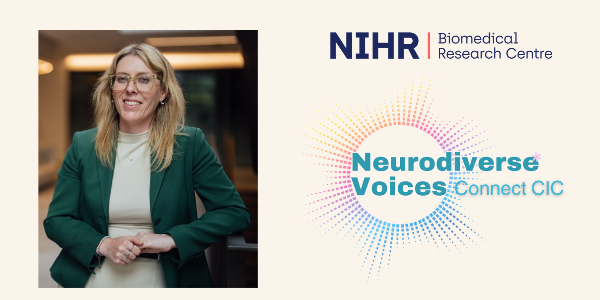
In this interview Andreia Costa, Project Manager for Training & Career Development at the Biomedical Research Centre: Oxford Health, reflects on the power of lived experience, the importance of putting neurodivergent voices at the heart of research, and her hopes for a more inclusive future.
Andreia shares how her daughter’s autism diagnosis and her own ADHD diagnosis led to her establishing Neurodiverse Voices Connect, a non-profit organisation that supports neurodivergent people and their families through connection, lived experience, support and collaboration.
Andreia is also Chair of the Neurodiversity & Disability Working Group at the University of Oxford’s Department of Psychiatry.
What inspired you to set up Neurodiverse Voices Connect?
My daughter Melody is autistic, and learning about neurodivergence through her helped me understand myself too. Knowing that autism can run in families led me to explore whether I might also be neurodivergent. I pursued assessments for autism and ADHD and, at age 42, I was diagnosed with ADHD.
Neurodiverse Voices Connect (NDV) began as a podcast. I wanted to support parents who were at the beginning of their neurodivergence journey and perhaps weren’t yet ready to reach out or talk to others.
Conversations around neurodivergence are improving, but stigma and judgement still exist, particularly around parenting. Sometimes it takes courage just to walk into a room and say, “I need support.” A podcast asks nothing of you – you can simply listen, in your own time, and hopefully realise that you are not alone.
That desire to help people feel less alone grew into our coffee mornings, peer support groups and, more recently, our NDV Community Support Evenings. Without really intending to, I realised I had piloted initiatives that were making a genuine difference to the people attending.
Everything we do is grounded in four core values: love, kindness, support and connection. My hope is to build a community where neurodivergent people and their families feel that they belong, their voices matter, and they don’t have to navigate their journeys alone.
With my very active ADHD brain, I have plenty of ideas for where NDV could go next – I just wish there were more hours in the day to make them all happen! Thankfully, I have an incredible Advisory Board who occasionally put the brakes on me!
How does your work as BRC Academic Training Manager connect with your passion for neurodiversity?
I feel incredibly lucky to have this job! When I joined the BRC, I hadn’t fully appreciated that I would be working alongside researchers and clinicians who have dedicated their careers to understanding neurodivergence and improving the lives of neurodivergent people.
A great example is the BRC Neurodiversity Conference. I led the organisation of the 2-day conference, which I would say have been two of the most rewarding days of my life. Together with an incredible organising committee and volunteers, we created a space that brought researchers, clinicians, local organisations and the neurodivergent community together, to explore gaps and priorities in mental health research.
The ripple effect from that conference is still being felt today. Connections and collaborations were created that have continued to grow, and seeing what can happen when we bring the right people together is incredibly rewarding.
For me, that’s where my BRC role and my passion for neurodiversity connect most strongly: bringing people together, creating opportunities for collaboration, and making sure that lived experience has a place in the conversation.
Why is it important that neurodivergent voices are at the centre of research?
For me, it comes down to a very simple principle: “Nothing about us, without us.” This was the theme of the Neurodiverse Voices Connect launch event in July, and it captures what I believe meaningful research and co-production should look like.
Historically, too many systems have been designed for neurodivergent people, rather than with neurodivergent people. This means that our needs can be misunderstood, overlooked or simply not met.
Neurodivergent voices need to be at the centre of research, not only in mental health, but across healthcare. Neurodivergent people can also live with a range of co-occurring physical and mental health conditions, and there is still so much we need to understand about whether treatments, interventions and healthcare pathways work differently for neurodivergent people.
I’m also passionate about co-production and meaningful involvement in research. I get involved in research studies whenever I can, and I find it fascinating. I love the collaboration between researchers and people with lived experience as it brings different forms of expertise together. It makes me feel that my lived experience is valued and, importantly, that it has a purpose.
The Body Focused Repetitive Behaviours Conference, brings together people with lived experiences and researchers. It has been a real pleasure to work collaboratively with Professor Clare Mackay to bring together our different perspectives and shared passions.
What is one thing you’d like more people to understand about neurodiversity?
If I had to choose one thing, it would be the understanding that neurodiversity is incredibly nuanced, and we need to move away from seeing it through extremes.
There are still so many myths and misconceptions. On one side, we sometimes hear that autism or ADHD are “superpowers”. I understand the importance of recognising strengths, particularly after decades of focusing predominantly on deficits, but describing neurodivergence only in terms of strengths can unintentionally minimise the very real challenges some people experience, including those with significant support needs or co-occurring learning disabilities.
At the other extreme, there are still people who view autism and ADHD purely as illnesses or something that needs to be “cured”. The reality is more complex. We can celebrate neurodivergent strengths whilst also acknowledging disability, challenges and the need for appropriate support. Those things can coexist.
Neurodivergence is much broader than autism and ADHD, although those are probably the two examples we hear about most. The term can encompass a much broader range of neurological and developmental differences, and even within the same diagnosis, no two people’s experiences will be the same.
Ultimately, I would like to reach a point where society is flexible enough to recognise that human brains work differently and people’s individual needs are understood and supported without them having to justify those needs through a label or diagnosis.
What gives you hope for the future of neurodiversity research and inclusion?
What gives me the most hope is connection and collaboration. I’m seeing more researchers, clinicians, organisations and, importantly, people with lived experience coming together and genuinely listening to one another.
Through my work at the BRC, the Neurodiversity Conference, as a Chair of the Neurodiversity & Disability Working Group at the Department of Psychiatry and, my involvement in research, and now Neurodiverse Voices Connect, I’ve seen first-hand what can happen when we create spaces where those different perspectives meet. Conversations turn into connections, connections become collaborations, and sometimes those collaborations lead to real change. That ripple effect is incredibly powerful.
There is still a long way to go. We need research that reflects the diversity within the neurodivergent community, looks beyond autism and ADHD, considers physical as well as mental health, and includes people with different communication styles, abilities and support needs.
I see many passionate people working towards that change, and that gives me hope. If we continue bringing together research, lived experience and community, with kindness and a genuine willingness to listen, I believe we can build a future where neurodivergent people aren’t simply included in systems designed for them – they are helping to shape those systems.