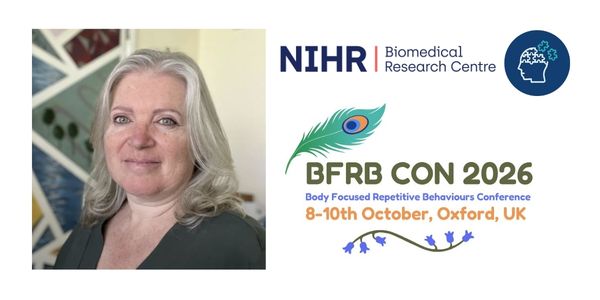
Body-focused repetitive behaviours (BFRBs) such as hair pulling, skin picking and chronic nail biting affect millions of people, yet they remain widely misunderstood and often hidden from view. In this quick-fire Q&A, Professor Clare Mackay, Co-Theme Lead in our Dementia Theme shares insights from her research and lived experience, exploring why these behaviours occur, what science is revealing about them, and why greater understanding is essential to improving support and care.
- For those who may not have heard of BFRBs, what are they, and what motivated you to study them?
Body-focused repetitive behaviours (BFRBs) include hair pulling, skin picking and chronic nail biting. Most of us do these things a bit, but for some, these behaviours become hard to control and can cause both physical damage and significant distress. Despite this, they remain stubbornly overlooked in research, clinical practice and our general understanding of human suffering. I know this suffering only too well – I lived with hair-pulling disorder (trichotillomania) for 40 years, and I hope that by putting this together with my three decades of studying the brain, I can contribute to our understanding of why these behaviours happen, why they’re so often misunderstood, and find ways to help people more effectively.
- Through your research, what have you learned about BFRBs that you think would most surprise people?
Probably the contrast between how common they are (around 5% of people experience distressing BFRBs) and how hidden they remain. Many people with BFRBs spend years believing they’re alone or that they simply lack willpower, so they hide their behaviours and never seek help. What surprised me was discovering that there is an enormous scientific landscape that can be explored to help us understand BFRBs, drawing on neuroscience, psychology, sociology, dermatology, genetics, emotion regulation, and even the biology of the skin and hair. For me, replacing self-blame with scientific curiosity changed everything.
- Your recently published book explores the science and lived experience of BFRBs. What do you hope readers will take away from it?
The question ‘how to stop’ is foremost for many people with BFRBs, and has driven most of the research and delivery of treatments, but I wanted to ask different questions. I used my combination of lived experience and neuroscience to explore why some of us acquire these behaviours, what function they serve, why we get stuck in vicious cycles, and why the consequences can make us feel so bad. BFRBs aren’t simply “bad habits” or niche psychiatric disorders, they’re common human behaviours with important lessons to teach us about emotion regulation, attention and mental health. Personally, I have found that compassionate understanding enables me to manage my own BFRBs much more effectively than my decades of fruitless attempts to ‘just stop’, and I wanted to share that.
- BFRB Con 2026 brings together researchers, clinicians and people with lived experience. Please tell us more about this event and why people should consider attending?
BFRB Con was founded on a simple idea: everyone connected with BFRBs has something valuable to contribute. It’s a CPD-accredited, multidisciplinary scientific meeting, and a welcoming, inclusive community event rolled into one, where researchers, clinicians and people with lived experience learn alongside one another as equals. Whether you’re attending to present your research, inform your clinical practice, promote your product, or because you’ve spent years struggling in silence (or watching someone you love struggle), you’ll be warmly welcomed.
- What developments in the field are giving you the most hope for the future of BFRB research and care?
It’s exciting to feel a growing momentum around BFRB awareness and research. By centring lived experience, we’re moving beyond simply treating these behaviours as something to be stopped, towards understanding why they happen, and what they can teach us about the relationship between the brain, the body and our wellbeing. My hope is for a future where nobody experiencing a BFRB will struggle for years before finding recognition, understanding and effective support.
Professor Mackay’s book “Keep Your Hair On” can be purchased on Amazon here.
Find out more and register for BFRB Con 2026 here.