
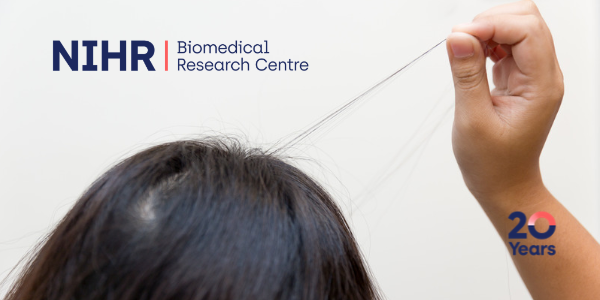
More than half of adolescents surveyed about their mental health had experienced repetitive behaviours such as hair pulling, skin picking and nail biting, according to research from the University of Oxford.
The study found that body-focused repetitive behaviours (BFRBs), as they are known, can be a significant source of distress, particularly among young people who also experienced anxiety, depression and bullying.
Researchers, supported by our NIHR Biomedical Research Centre (BRC): Oxford Health, asked questions about BFRBs to more than 5,400 school pupils aged between 11 and 18, mainly in Oxfordshire and Liverpool, as part of the larger OxWell Student Survey. For those that had experienced BFRBs, they were asked to what extent those behaviours upset or distressed them, ranging from ‘not at all’ to ‘a great deal’.
The data, published in the BMJ Mental Health, showed:
- 58.5% of young people in the sample reported at least one BFRB.
- 13% experienced these behaviours as a significant source of distress (answering that it caused ‘quite a lot’ or ‘a great deal’ of distress or upset).
- The most commonly reported behaviour was nail biting (43.6%), followed by skin picking (31.3%) and hair pulling (14.5%), with 17.6% of those experiencing BFRBs reporting two or more.
- Hair pulling and skin picking were associated with substantially higher levels of distress than nail biting (37% and 29% respectively versus 11%).
- Girls and transgender/gender-diverse young people were substantially more likely than boys both to experience BFRBs and to find them distressing. Around one in four transgender/gender-diverse young people and one in six girls reported distressing BFRBs, compared with around one in eighteen boys.
- More than a third of young people with anxiety and depression (34%) had experienced distressing BFRBs, as well as 27% of those who had experienced bullying.
The researchers also found that distressing BFRBs were reported by around one in five young people who identified as autistic or having ADHD — approximately twice the rate seen in those without these conditions. This difference was largely explained by higher levels of emotional distress and experiences of bullying, rather than neurodivergence itself.

Lead author Professor Clare Mackay from the University of Oxford’s Department of Psychiatry and BRC: Oxford Health Dementia Theme Co-Lead, who has experienced BFRBs herself, said:
“These findings show that BFRBs are common in adolescents, and that they are strongly associated with emotional distress and social adversity. This distress often goes unrecognised because these types of behaviours are rarely discussed in schools, healthcare or wider society, and so those experiencing them often have little support.
“BFRBs aren’t simply bad habits. They’re often signs that a young person is struggling. Asking whether someone ever pulls, picks or bites at themselves in a way that upsets them could open an important conversation. If we recognise these behaviours earlier, we have a much better chance of offering support before they become entrenched.”

Co-author Professor Polly Waite, Deputy Director of the Oxford Centre for Emerging Minds Research and NIHR BRC: Oxford Health’s Mental Health in Development Theme Co-Lead, said:
“This research highlights the need for better support for young people with BFRBs. Shame and stigma can make it difficult for young people to talk about these behaviours or seek help. We need to open up conversations about BFRBs, challenge the stigma surrounding them, and help young people realise they are not alone.”
The data came from the OxWell Student Survey which is conducted every two years. The findings are shared back with schools to inform policy and practice, as well as with local authorities to guide education and mental health provision, and to shape national policy on education and wellbeing.
The findings follow another recent qualitative study highlighting the central role of shame in young people who experience hair pulling. Twelve adolescents took part in semi-structured interviews, which found that shame was an enduring emotion that triggered, maintained and exacerbated hairpulling.
The findings were published in the journal Psychology and Psychotherapy: Theory, Research and Practice.