

New research has highlighted important gaps in the way quality of life is measured for people living with multiple long-term conditions (MLTCs), raising questions about whether existing approaches capture what really matters to patients.
The study, “Quality of life measurement in people with multiple long-term conditions: a co-produced scoping review and visual evidence map”, was published recently online in The Lancet Primary Care.
Someone is classified as having MLTCs when they have two or more ongoing physical or mental health conditions. For millions of people across the UK, these conditions can affect daily life, independence, wellbeing and access to care.
The work was funded through the NIHR Team Science Award and brought together 10 co-investigators from 10 institutions across the UK, combining expertise in health measurement, lived experience and applied health research.
The research examined how quality of life has been measured in studies involving adults with MLTCs. It found that most existing measures are generic and that some important groups, including people with vision loss, cognitive impairment or a palliative condition, have been underrepresented in the evidence.
The panel also identified important factors that influence quality of life were not captured in exiting measures, including financial insecurity, access to technology, use of mobility aids, stigma, and disease stage.
Measures used in research can influence how the success of treatments and health services is judged. If they do not adequately reflect the experiences and priorities of people with MLTCs, important effects on people’s everyday lives could be missed.
A key strength of the project was its focus on co-production. An 11-member lived experience panel worked alongside researchers to help shape the research questions, interpretation and outputs, including an interactive visual evidence map designed to make the findings more accessible.
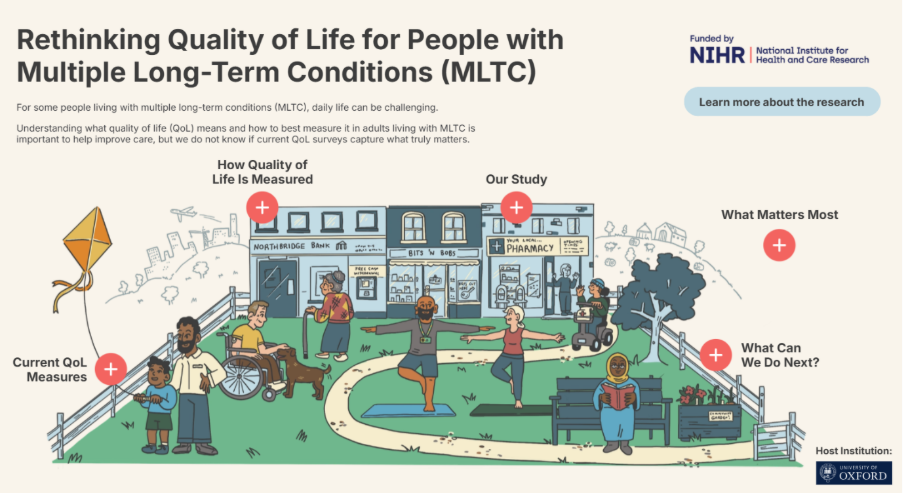
Project lead Dr Megan Kirk Chang and Naomi Kuryk, a member of the lived experience panel, recently took part in a Lancet Primary Care in Conversation With podcast to discuss their involvement in the project. Naomi shared what it meant to her to co-produce the evidence map and see herself represented in the graphics. Listen to the podcast on Spotify.

Dr Kirk Chang is a NIHR Biomedical Research Centre (BRC): Oxford Health Preventing Multiple Morbidities subtheme lead and a Senior Researcher in Metabolic Psychiatry at the University of Oxford’s Department of Psychiatry.
Dr Kirk Chang said: “Collaboration has been at the heart of this study. Working alongside researchers from different backgrounds and people with lived experience has helped us ask better questions and challenge our assumptions about what quality of life really means for people living with multiple long-term conditions.
“Our findings suggest that researchers will need to consider more carefully whether quality-of-life measures reflect the priorities of people managing several conditions at the same time. Ultimately, better measurement could help researchers, clinicians and policymakers understand which treatments and services make a meaningful difference to people’s lives.”