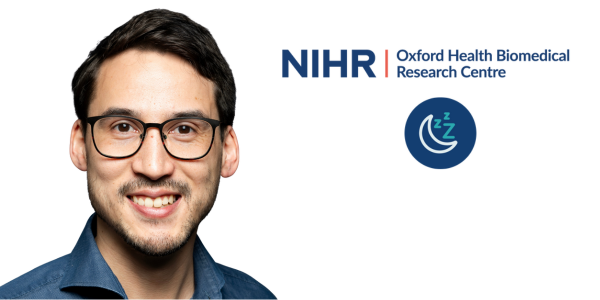
In the latest of our 60 seconds interview series, we spoke with Dr Shaun Davidson Oxford Health Biomedical Research Centre (OH BRC) Better Sleep Theme researcher, and Postdoctoral Research Associate in the University of Oxford’s Department of Engineering Science.
Dr Davidson talks about his current research into wearable devices that monitor circadian rhythms (body clock that influences sleep-wake patterns) and sleep and the interdisciplinary and translational nature of his work.
Dr Davidson is a recipient of a Better Sleep pump-priming grant from OH BRC. A pump priming award provides short‑term, small‑scale funding to kick‑start innovative research ideas that are not yet ready for major grant applications.
Dr Davidson shares how this funding enables him to collaborate on a study which aims to validate a wearable sleep tracking system against a “gold standard” sleep monitoring system.
Tell us a little about yourself, and what attracted you to working for the Oxford Health Biomedical Research Centre (OH BRC)?
I’m a biomedical engineer based at the Institute of Biomedical Engineering (IBME) at the University of Oxford. My current research focuses on using wearable devices to monitor circadian patterns and sleep, and how changes in these relate to health outcomes.
I’ve always enjoyed working in an interdisciplinary environment, where I can interact with and learn from experts from fields different from my own. I also value working on translational, applied projects that have the potential to make a tangible difference in people’s lives. The OH BRC provides a great environment that combines both!
What is the focus of the work in your department?
The IBME focuses on cross-disciplinary biomedical engineering research. There’s a lot of close collaboration with clinicians as the institute is conveniently situated between Oxford’s Churchill and John Radcliffe Hospitals.
There’s a wide variety of ongoing research, including developing Artificial Intelligence (AI) models for predicting disease from electronic health records, using video cameras to remotely monitor vital signs, and developing neural implants to help manage epilepsy.
What does a day in your current job look like? What are you currently working on?
My days are varied, which is something I like. I work between the IBME, the John Radcliffe Hospital, and the Sleep and Circadian Neuroscience Institute. My work ranges from computer-based activities, such as data analysis and software or model development, to hands-on involvement in the running of our studies.
I was recently awarded a pump priming grant by OH BRC’s Better Sleep Theme for a collaborative study with Theme Co-Lead Professor Simon Kyle’s group at the Sleep and Circadian Neuroscience Institute. This study will validate an in-house wearable sleep tracking system against gold standard sleep monitoring in the sleep laboratory and forms a major part of what I’m currently working on.
How did you get to where you are today?
I’m from New Zealand and did my bachelor’s and PhD in Mechanical Engineering there. My PhD was on real-time modelling of cardiovascular behaviour during sepsis in intensive care, and inspired a lot of my interest in interdisciplinary, translational research combining engineering and healthcare.
There’s a lot of fascinating research happening at Oxford in this space, which led to my applying to join Professor Lionel Tarassenko’s Biomedical Signal Processing and Machine Learning group. Our group’s focus is on using state-of-the-art technology and algorithms to deliver care agnostic to patient location.
I’ve really enjoyed my journey here, and I also have a real fondness for old buildings and architecture for which Oxford is a pretty good place to be.
Who or what inspires you?
I owe a lot of my drive and curiosity to my parents, and the ongoing support of my wonderful partner, all of whom are incredibly supportive and indulgent of my many interests. Beyond this, I am deeply motivated by the joy of learning and have always found human biology fascinating. I feel privileged to be surrounded by such an inspiring diversity of people, projects, and research across a wide range of disciplines.
If you were not in your current job, what would you like to be doing?
I really enjoy creative writing and would have loved to have been an author. I do still really enjoy the process of telling a story or putting together a narrative when writing in academia, though there are obviously far stricter rules about how to do that. Perhaps creative writing is something I can revisit when I retire.
Contact OH BRC: ohbrcenquiries@oxfordhealth.nhs.uk